Wondering where to put filler in the face? Learn where filler may help, when it may not, and how a whole-face assessment guides natural-looking results.



130 Tibet Ave
Suite 105
Savannah, GA 31406
We are located in Tibet Professional Center with plenty of parking available.


Medically reviewed by Lillie Brannen, PA-C
If you’re researching where filler can be placed in the face, the more useful question is usually not “Where can filler go?” but “Where would filler actually make a meaningful difference for me?”
Dermal filler can be used in many areas of the face, but the fact that an area can be injected does not mean it should be. The right placement depends on your anatomy, existing volume, previous treatments, skin quality, facial movement and the change you are actually trying to achieve.
At Park Aesthetics, we use a whole-face assessment to decide where filler may help, where another treatment may make more sense and where we would recommend leaving things alone. Here, we’ll walk through where filler is commonly used, how different areas relate to one another and how an injector decides what is actually worth treating.
Aging affects several parts of your face at the same time. Volume shifts, soft tissue moves, skin quality changes, and the underlying structures gradually change as well. These changes can influence how different areas of the face relate to one another.
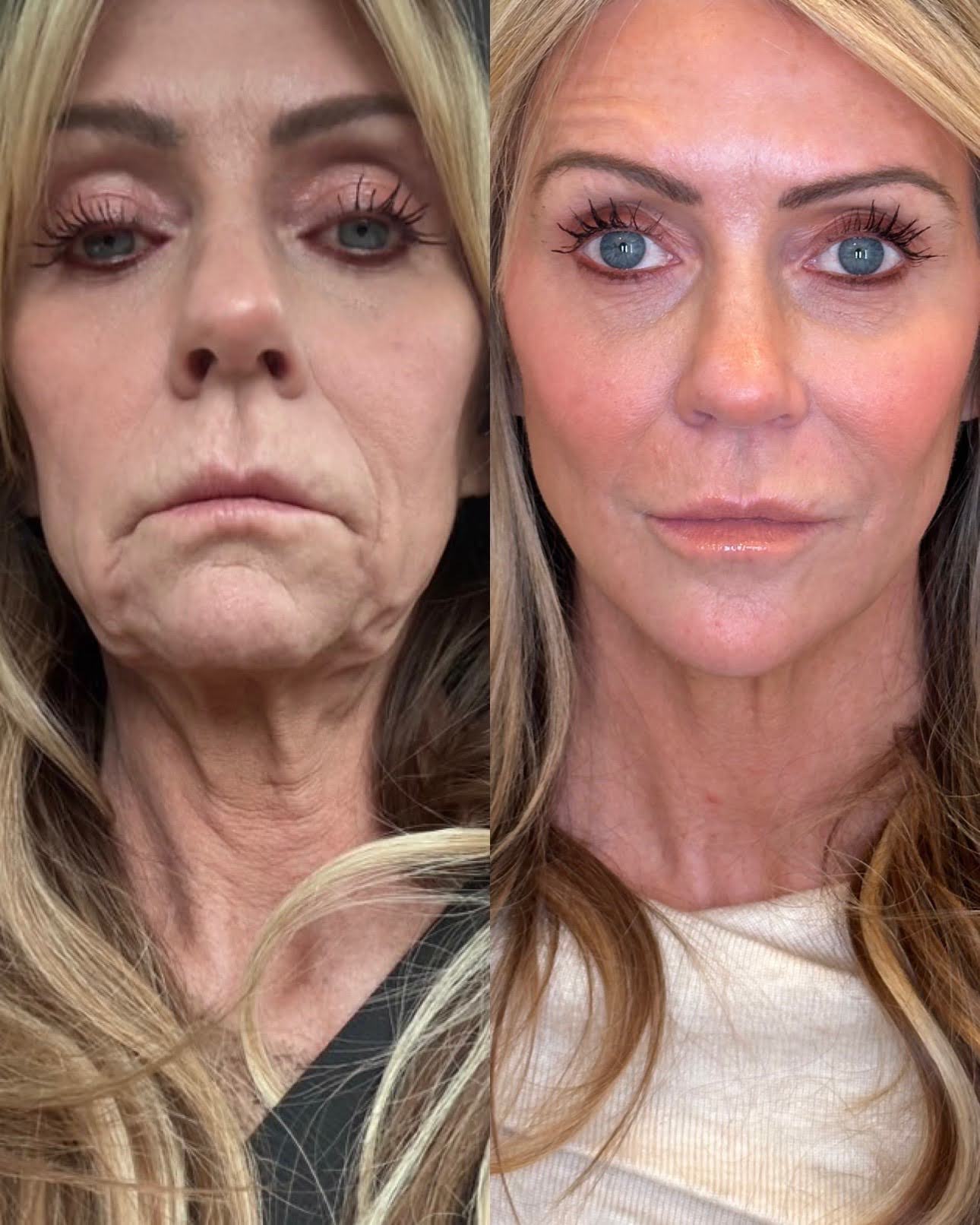
The area that bothers you most is not always the area that needs filler. A whole-face assessment considers how bone structure, volume, skin quality and movement interact before deciding whether adding volume would actually improve the concern. The goal is to preserve the features and expressions that already look like you—not to treat every visible sign of aging.
Dermal filler may be considered in areas including the cheeks, temples, lips, chin and jawline, as well as select areas around the mouth and under-eyes in carefully chosen patients. The right placement depends on your anatomy, where volume has changed, previous treatment and whether filler is actually the best tool for the concern.
Here’s a closer look at several commonly discussed regions—and why evaluation matters before deciding to treat them:
Cheek filler can restore selected areas of volume loss or add structural support through the midface. Placement matters: treating the central cheek creates a different effect than treating the lateral cheek. Just as importantly, not every patient asking for cheek filler needs more cheek volume, which is why we assess the surrounding face before adding product.
The temples are one of the areas where age-related change can become surprisingly visible. Temporal bone resorption and soft-tissue volume loss can create hollowing that changes the transition from the forehead to the cheek. In the right patient, restoring that support can make the upper face look less skeletal and more balanced without making any single feature look “filled.”
Under-eye filler is appropriate for a relatively narrow group of patients. What looks like a hollow may instead be influenced by pigmentation, visible vasculature, fluid retention, skin quality or the structure of the surrounding midface. Because filler can worsen puffiness or heaviness in the wrong candidate, this area requires especially careful evaluation.
Nasolabial folds and marionette lines are normal parts of facial anatomy and do not automatically need to be filled. In some patients, carefully placed filler can soften a specific crease. In others, the appearance is being influenced by surrounding volume, skin laxity or lower-face structure, making direct filler a poor first choice. We evaluate the cause before treating the line itself.
Lip filler can add or restore volume, define your lip border, and improve symmetry. Rejuvenation here doesn't have to mean noticeably larger lips. Small adjustments to shape and hydration can refresh the area without changing your natural look.
Chin filler can improve projection and structural support when the chin is contributing to a patient’s concern. Because chin projection affects how the lips, profile and jawline are perceived, treating the chin can sometimes create more meaningful change than adding volume directly to the area a patient first noticed.
Jawline filler can add structural definition in appropriate patients, but it cannot reliably correct significant skin laxity or jowling. Adding volume to camouflage laxity can sometimes make the lower face look heavier, so determining why the jawline looks less defined matters before deciding to treat it.
There is no single “best” combination for every face. The right pairing depends on why the face looks the way it does. Age-related volume loss may make the cheeks and temples a logical place to start; a naturally weak lower face may point more toward the chin and jawline; early jowling may change the plan entirely. The examples below are useful for understanding how different areas influence one another, not treatment packages every patient needs.
The midface and temples are common places to see age-related volume loss, which is why they are often assessed together. The malar region provides major structural support through the center of the face, while temporal hollowing can make the upper face look more skeletal. When both are contributing to the overall change, restoring them together can create a more cohesive result than treating one area in isolation.
Midface volume loss and tear-trough hollowing often show up together. Improving cheek support can reduce how prominent the under-eye hollow appears, and direct tear-trough filler is only added after individual assessment. But this won't erase dark circles caused by pigmentation or vascular visibility.
Flattening through the midface and deepening smile lines are connected. Restoring cheek support first, rather than filling every crease directly, tends to soften the folds while keeping your natural expressions intact.
Weak chin projection can make your entire jawline look less defined. Combining chin and jawline filler creates a more continuous profile, and product choice or placement depth may differ between the two areas since structural support is the goal.
Your cheeks influence the middle third of your face, while your chin and jawline shape the lower third. Treating these as connected proportions, rather than separate features, is central to the facial-balancing approach we use at Park Aesthetics.
This combination suits patients seeking subtle enhancement across several proportions rather than anti-aging correction alone. Cheek structure adds midface contour, lips influence central proportions, and chin projection balances the lower face. Restraint keeps any single feature from dominating the others.
An injector decides where you need filler by assessing your bone structure, existing proportions, and where volume has been lost versus where it remains. That evaluation goes well beyond copying a trending photo or a generic injection map.
A thorough assessment typically factors in:
Treatment may also be staged across multiple appointments. Our practitioners start with the Park Personal Blueprint—a full facial assessment that considers anatomy, proportions, aging patterns, movement, skin quality and previous treatment—then build the plan around what will make the most meaningful difference rather than a standard template.
No, the same filler shouldn't be used everywhere, since products vary in firmness, flexibility, lifting capacity, and composition. A product built for chin or jawline support isn't usually right for a softer, more mobile area like the lips.
Hyaluronic acid (HA) fillers and biostimulators are different tools with different jobs. HA fillers vary in rheology—their firmness, flexibility, cohesivity and ability to hold shape—so product choice should match both the tissue plane and what we are trying to mimic. Biostimulators such as Sculptra and Radiesse are used differently; when Radiesse is being used primarily for collagen stimulation at Park, it is placed in appropriate soft-tissue planes where tissue remodeling is the goal rather than simply being used as a generic structural filler.
At Park Aesthetics, the products we currently carry include Juvéderm and Restylane hyaluronic acid fillers, along with Sculptra and Radiesse as biostimulatory options. Our injectors are also trained in other filler families and rheologies, even when we choose not to stock them. The point is not brand loyalty: each product behaves differently, and the product should be chosen for the plane, the anatomy and the job it needs to do.
That distinction matters because fillers are not interchangeable. A product selected for soft, mobile lip tissue should not automatically be used for deep structural support, and a filler designed for one plane may behave poorly in another. Product selection should follow the anatomy and the outcome—not whichever syringe happens to be popular.
No. At Park, “full-face” refers more accurately to the assessment behind the treatment plan—not a requirement to place filler throughout the face or use a certain number of syringes. A patient may benefit from one carefully selected area, several staged treatments, dissolving previous filler, a skin-focused treatment or no filler at all.
Adding more volume can shift facial proportions instead of improving them. Not every visible line, hollow or contour change is a volume problem: skin laxity, pigmentation, texture, muscle movement and existing filler can all change what the best next step looks like. Sometimes better facial balancing means adding filler. Sometimes it means treating something else—or leaving an area alone.
We treat filler and Botox as complementary tools: filler adds structure and volume, while Botox addresses the muscle activity behind expression lines.
Filler should only go where a qualified professional has evaluated your anatomy and determined that the location and product are appropriate for you. There's no reliable DIY map for this.
Certain areas of your face contain important blood vessels and structures, so anatomical knowledge, product selection, injection depth, and technique are all critical. Some concerns are also poor candidates for filler even when the technique is possible nearby. Under-eye puffiness, significant skin laxity, certain folds, and an already well-projected feature may call for a different approach.
The better question is where filler suits your anatomy and your specific concern, which is best answered in a consultation rather than an online diagram.
Filler creates visible change immediately, but the first look is not the final result. Swelling can temporarily change shape, volume and symmetry, and settling time varies by treatment area, product and individual response. We evaluate the result after the expected swelling period rather than judging it on treatment day.
Temporary swelling, tenderness, redness, or bruising can affect your appearance during early healing. Settling time varies by treatment area and by how your body responds, so it's best to follow our post-treatment instructions rather than a generic timeline.
There is no universal filler recipe, and you should not have to decide how many syringes—or even which treatment—you need before anyone has evaluated your face. At Park Aesthetics in Savannah, we start with a whole-face assessment to identify what is contributing most to the concern and which options are most likely to make a meaningful difference.
For patients who know something feels different but are not sure what they need, the Park Personal Blueprint is designed for exactly that conversation. We look at anatomy, aging patterns, skin, movement and previous treatment, then separate what we would prioritize now from what could wait—and what we would not recommend treating at all.
Contact us
We would love to hear from you!


.png)